| Parameter | Value |
|---|---|
| Spatial unit | H3 Resolution 8 centroids (~3,686 origins) |
| Percentile | 50th percentile (median) |
| Max trip duration | 120 minutes |
| Modes | Walk, Bike, Car, Public Transit (×2 transfer scenarios) |
| PT egress mode | WALK |
| PT max walking time | 15 minutes, 20 minutes (2 scenarios of egress) |
| PT departure datetime | Wednesday 04/02/2026 at 08:00 AM |
| PT max transfers (scenario 1) | max_rides = 2 (1 transfer) |
| PT max transfers (scenario 2) | max_rides = 3 (2 transfers) |
| Cycling max Level of Traffic Stress | LTS ≤ 3 (comfortable streets) |
| Elevation model | MINETTI metabolic-equivalent |
5 Travel Time Matrix
Script: 03_ttm_gridh3.R
Package: r5r (Pereira et al. 2021)
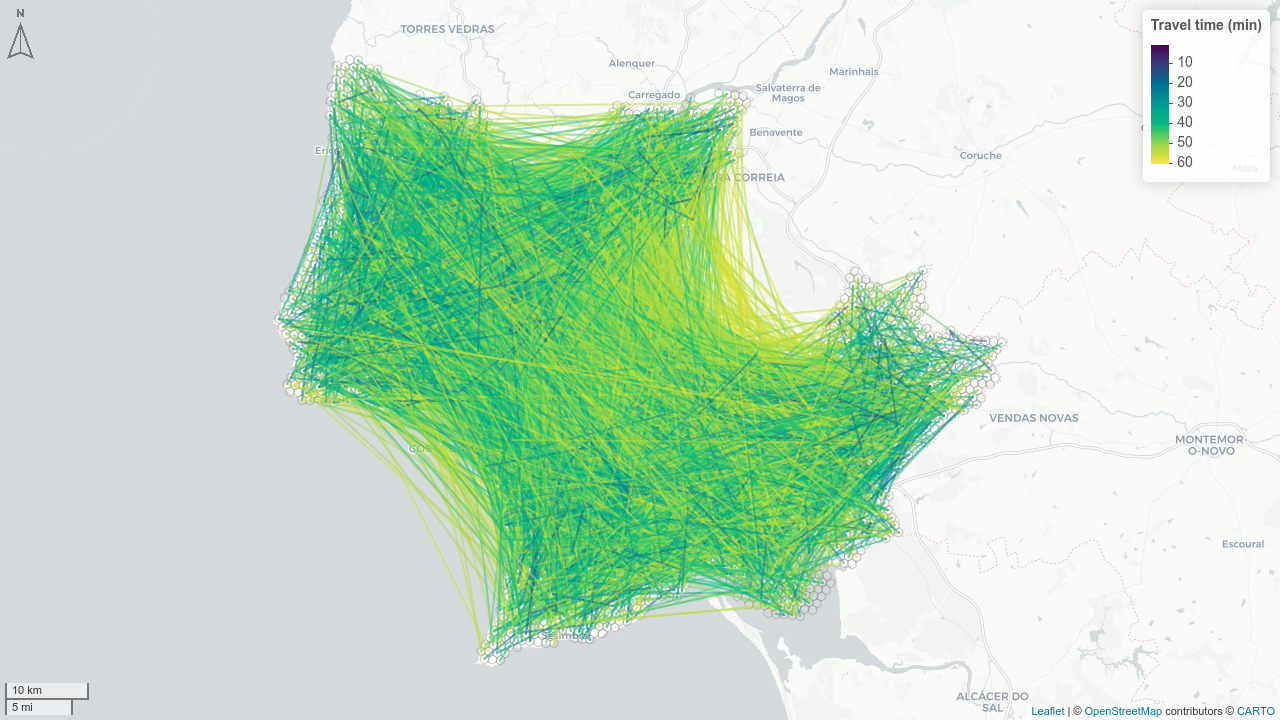
A travel time matrix (TTM) is computed between all H3 grid centroids for the AML, for each transport mode, using r5r::travel_time_matrix(). The parameters used are:
Note
The 50th percentile travel time is used so that results represent typical (median) travel conditions rather than best- or worst-case scenarios. All parameters not listed here use r5r defaults.
This process is long and computationally expensive. It is recommended to run it in a powerful machine. The travel_time_matrix() function does not compute the geometry of the routes, only the travel times. The geometry of the routes is computed in the accessibility section.
The results are stored so we have a OD matrix of travel time between all H3 cells for each transport mode and scenario.