Installation
You can install the stable version of GTFShift from CRAN:
install.packages("GTFShift")For the development version, fetch from GitHub:
# install.packages("remotes")
remotes::install_github("U-Shift/GTFShift")Key functions
GTFShift provides methods for the entire workflow of bus lane implementation prioritisation, but also other useful functions for GTFS and OSM data gathering and manipulation. For detailed examples on their functionality, refer to the articles.
Prioritise
The main purpose of GTFShift is to support the decision-making process for bus lane implementation prioritisation. This article presents a step-by-step guide on how to use the package to achieve this goal, from data gathering to analysis and visualization.
Getting transit data
Starting with a valid GTFS feed is the key for a successful analysis. GTFShift includes a method to load feeds that simultaneously scans for any integrity errors and fixes them automatically.
If the feed location is unknown, it also provides a database listing GTFS for Portugal and a method to query worldwide open catalogues by city or country names or even a bounding box.
Filter
GTFS feeds do not have a defined scope regarding its coverage of the transportation system. Some can be bounded to one agency, whereas others can aggregate several modes in the same city, or even national wise.
From the simpler to the most complex feeds, some analysis require to narrow the perspective. GTFShift provides some to help in this process.
Aggregate
Public transit analysis takes advantage of the standardized GTFS format. However, its provision by operator makes it difficult for network aggregated analysis, considering connectivity and multimodality.
GTFShift includes a method to easily generate an aggregated GTFS file given several instances.
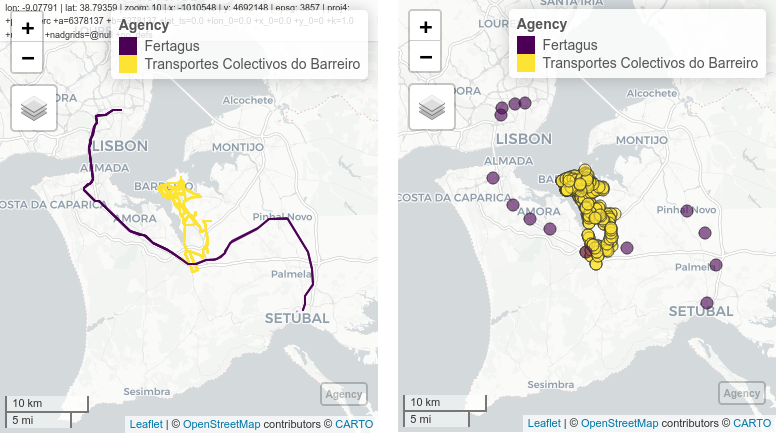
Aggregated GTFS for Fertagus and Transportes Coletivos do Barreiro operators
Analyse
Analyzing public transit feeds is important to understand its territorial coverage and dynamics, both on its spatial and temporal dimensions.
GTFShift provides several methods that encapsulate pre-defined methodologies for them, for instance, analysing hourly frequency per stop, route or road segment.
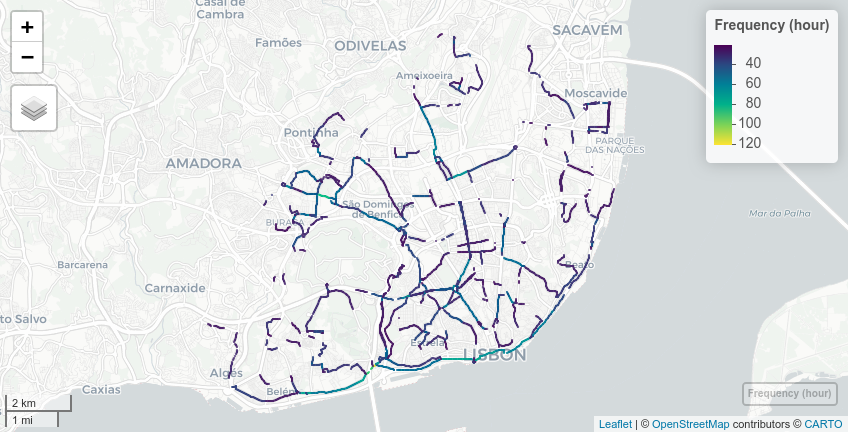
Aggregated route frequency for Carris Lisboa operator, at 8:00
OSM Data
OpenStreetMap (OSM) is an important data source for transit analysis, due to its rich, open, and detailed geographic data.
GTFShift includes some methods that allow to access its information directly, namely to export bus lanes, get centerlines for the road network and export the OSM transit routes.
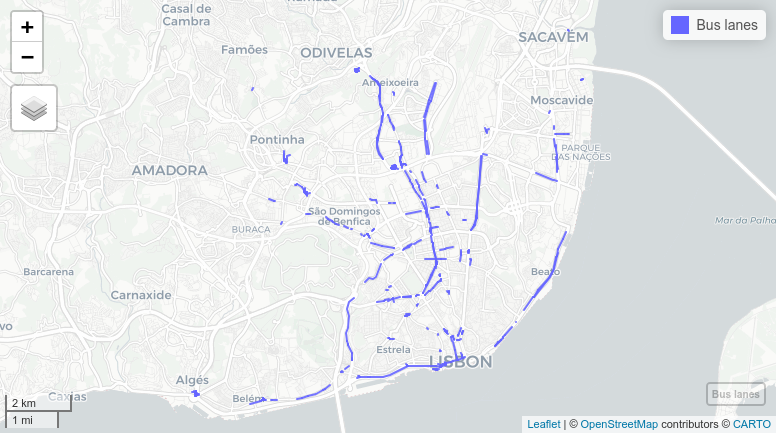
OSM exported bus lanes for Lisbon
Real Time transit data
Real time operational data provides valuable insights about how planned operation performs in practice and how it interacts with the urban traffic conditions.
GTFShift provides several methods to enable this data collection and analysis.
Contribute to OSM
OpenStreetMap (OSM) is a collaborative project that relies on community contributions.
GTFShift includes methods to facilitate the process of contributing to OSM, specifically for updating bus lane information based on the analysis results.
Generate GTFS with OSM geometries
The lack of standardization on GTFS shape geometries hampers aggregated analysis of different feeds and the association of planned service information with other urban dimensions such as the infrastructure topology.
GTFShift provides methods to generate a GTFS file with OSM geometries.